Keeping a Food Plant Safe, Running and Audit-Ready
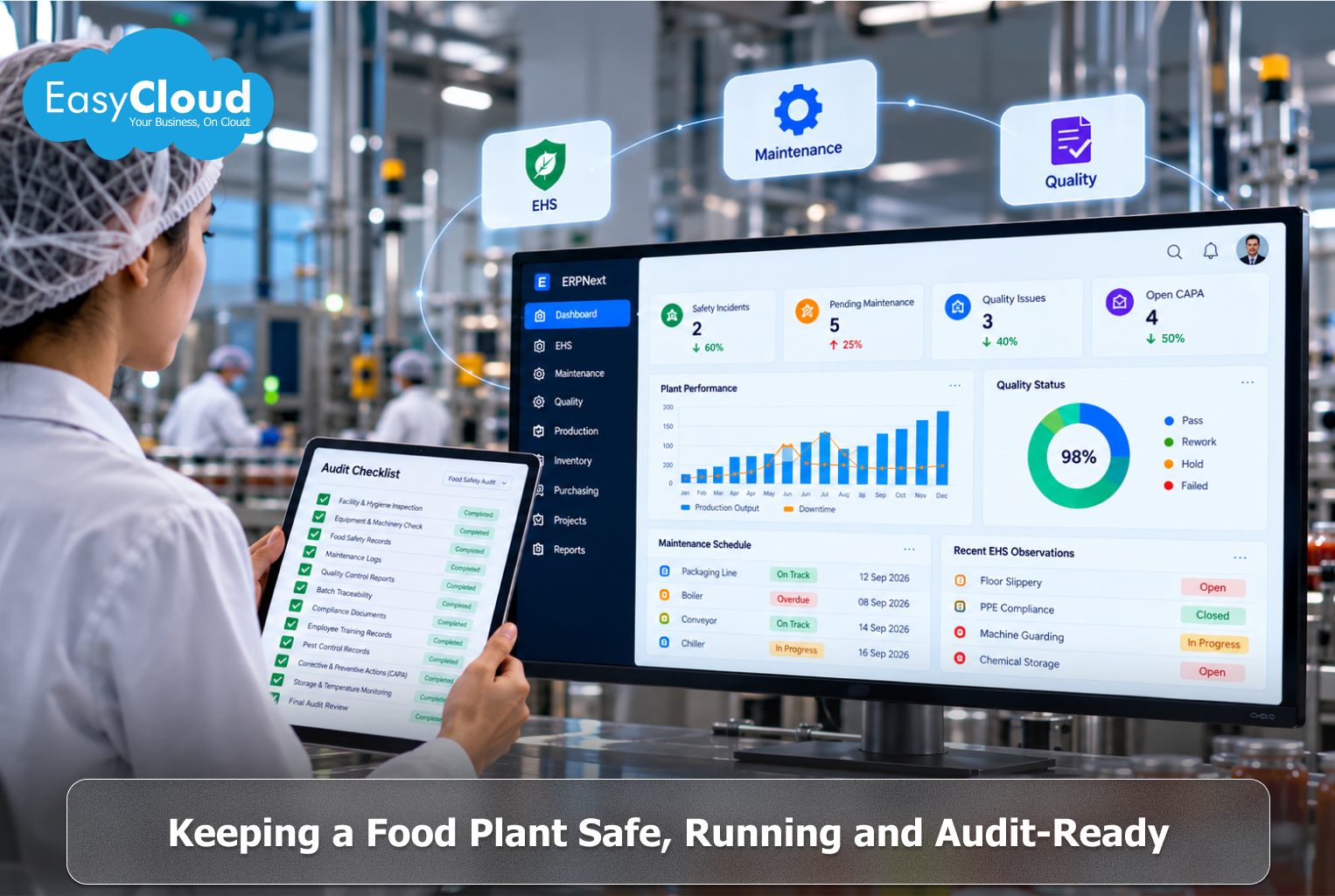
In food processing, three things decide whether a plant earns its reputation: how safe its people are, how reliably its machines run, and how consistently its product meets standard. Yet in many plants these three functions live in separate registers, spreadsheets and individual heads. Information arrives late, ownership is unclear, and problems get solved twice or not at all. At EasyCloud, we recently worked with a leading food processing company to bring all three onto a single digital backbone built on ERPNext.
The Challenge
Food plants run on tight schedules and thin margins. A line that stops for an unplanned breakdown, a quality deviation that reaches a customer, or a safety incident on the floor can each undo weeks of good work. The company wanted one system where safety, maintenance and quality could be managed with the same discipline as production, without adding paperwork for shop-floor teams.
Environment, Health and Safety
Incident reporting, hazard observations, safety inspections and corrective actions moved from paper registers into one system. Every issue now has an owner, a deadline and a visible closure trail. Supervisors can log an observation in moments, and management can see what is open, what is overdue and where risks cluster. Safety reviews no longer start with hunting for records; they start with patterns, so the team can prevent the next incident rather than document the last one.
Machine Maintenance
We replaced firefighting with planned discipline. Preventive schedules, breakdown logs, spare-parts tracking and downtime history now sit in one place. Technicians know what is due and when, stores know what to stock, and production planners know which machines will be unavailable. Over time, the breakdown history shows which assets cause the most trouble, helping management decide whether to repair, overhaul or replace them. Maintenance becomes a managed function with data behind it, not a reaction to whatever stopped last.
Quality Management System
Inspection checklists, non-conformance records, CAPA and document control now follow one workflow. Batch quality data links back to production, so tracing an issue to its source takes minutes instead of days. Controlled documents stay current, and records are ready when auditors ask. Audit preparation becomes a routine report rather than a scramble across folders and file cabinets.
The Real Gain Is the Connection
The biggest benefit came from linking the three areas. A machine fault can trigger a quality hold. A quality deviation can raise a maintenance job. A safety observation on a line can point to the equipment behind it. When EHS, maintenance and quality share the same data, teams stop working in silos and start solving root causes together. Leadership also gets a single, reliable view of plant health instead of three partial ones.
Built for Adoption
A system only works if people use it. We kept screens simple, workflows close to how the plant already operates, and rollout in focused phases so teams gained confidence step by step. Training centred on real daily tasks rather than software features.
Looking Ahead
For food manufacturers facing tougher audits, tighter margins and rising customer expectations, a connected approach to EHS, maintenance and quality is no longer a luxury. It is how a plant stays safe, stable and audit-ready every single day.
If your plant still runs these functions on separate registers and spreadsheets, EasyCloud would be glad to show you what a connected setup looks like.
