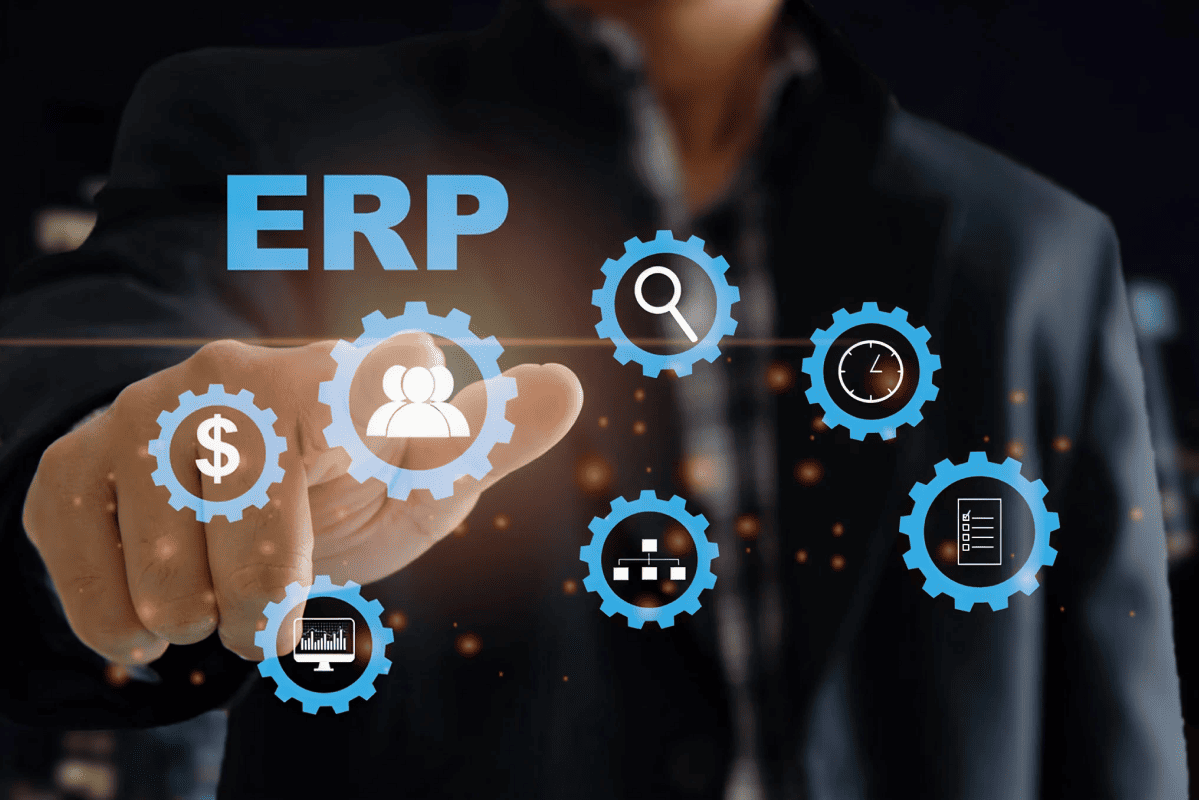
Enterprise Resource Planning (ERP) is a software tool assisting corporations in optimizing their key business operations—such as finance, human resources, manufacturing, sales, procurement, and supply chain—by offering a consolidated perspective of activities and ensuring a sole true source.
Think of a company as a human body—just as essential functions like digestion and sleep keep the body running, businesses rely on core processes like supply chain and sales. While these functions operate independently, they are deeply interconnected, meaning disruptions in one can impact the entire system.
An ERP system serves as the central nervous system of a business, seamlessly integrating and managing these critical operations to ensure efficiency and smooth functionality.
ERP began over a century ago as paper-based production scheduling. By the 1960s, manufacturers adopted computerized systems, leading to standalone solutions like MRP. In the 1990s, ERP expanded across industries, and with cloud technology, it became more accessible. Today, AI and machine learning enhance ERP, driving efficiency and real-time insights.
An ERP system consists of integrated modules that share a common database, enabling seamless communication across departments. Each module focuses on specific business areas like finance, logistics, procurement, or HR, allowing companies to customize and scale as needed.
Modern ERP systems integrate with CRM, HCM, e-commerce, and industry-specific solutions, providing a unified view of data for improved efficiency and collaboration. They connect via APIs, Enterprise Service Bus (ESB), or Integration Platform-as-a-service (iPaaS), ensuring flexibility and synchronization across various software applications.
Installed in a company’s data center, on-premise ERP offers full control but requires handling installation, updates, and maintenance.
Hosted on a third-party server, accessed via subscription. Provider manages maintenance, updates, and security.
Combines Tier 1 on-premise for HQ and Tier 2 cloud-based for subsidiaries. Ideal for gradual cloud transition.
Blends on-premise and cloud. Flexible, supports compliance, and eases transition toward full cloud adoption.
Helps startups move beyond spreadsheets, manage sales, financials, and operations with scalable, cloud tools.
Designed for midsize firms with analytics, rapid deployment, and modular scalability for growing needs.
For large/global firms with embedded AI, automation, and hybrid deployments to transform business processes.
ERP systems integrate core business processes into a unified platform, providing real-time insights that help organizations optimize operations and make data-driven decisions.



2nd Floor, BabuKhan Millenium Center, Somajiguda, Hyderabad, Telangana, 500082
23600 Mercantile Road, Suite C-100, Beachwood, OH 44122
© 2026 EasyCloud. All Rights Reserved. Privacy Policy